What is happening with Uyghur Muslims in China?

Uyghur Muslims Issues Facing in China
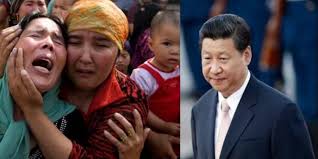
Human rights groups believe China has detained more than a million Uighurs over the past few years in what the state defines as reeducation camps . There is evidence of Uighurs being used as forced labour and of women being forcibly sterilised. The US is among several countries to have accused China of committing genocide and crimes against humanity through its repression of the Uighurs. China denies such allegations, saying it has been combatting separatism and Islamist militancy in the region.
Uyghur Tribunal’ opens with testimony of alleged rape, torture
● A London-based people’s tribunal is investigating whether China’s alleged persecution of its Uighur minority amounts to genocide, with witness testimony detailing mass torture, rape and a range of other abuses.
● The Uyghur Tribunal has no state backing and any judgement would not be binding on any government, but it has drawn a furious response from Beijing, which dismissed the hearings as a machine producing lies .
● The first hearings take place over four days, from 4th to 7th, and are expected to draw dozens of witnesses. A second session is expected in September.
● The nine United Kingdombased jurors of the tribunal, including lawyers and human rights experts, intend to publish a report in December on whether China is guilty of genocide.
● The first witness to testify on Friday, Qelbinur Sidik . an ethnic Uzbek teacher from Xinjiang’s capital Urumqi, said she was ordered by the Chinese Communist Party bosses to take Mandarinlanguage classes in two fetid and crowded re-education camps, one male and one female, for Uighurs.
● China is believed to have detained more than a million Uyghurs and other Muslims in Xinjiang, a large region in north-western China that is home to various ethnically Turkic peoples. The state has been accused of human rights abuses in the region, including forced labour,sterilisation and rape.
Tying religion to extremism
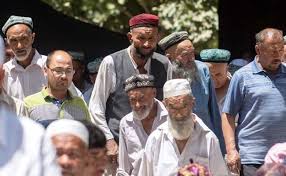
● Most of those detained in Xinjiang are sent to reeducation facilities prison-like camps where they are held for indeterminate periods of time without charge. But others have been given formal prison sentences, the number and severity of which have increased dramatically since 2017.
● Publicly available detention or charging documents are rare, but those that do exist demonstrate how the state has worked to tie ordinary religious expression in Xinjiang to extremism or political separatism.
Uyghur exiles describe forced abortions, torture in Xinjiang
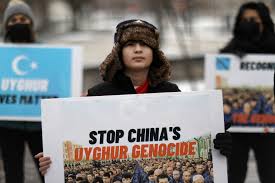
● The Chinese government has also employed a welldocumented, state-funded mass birth-prevention strategy to biologically destroy the Uyghur community. The Uyghur women are sterilised, subjected to abortions and Uyghyur men of childbearing age are sent to internment camps.
● China explicitly admits the purpose of these campaigns is to ensure that Uyghur women are no longer baby-making machines.
● The three witnesses include a woman who said she was forced into an abortion at 6 1 2 months pregnant, a former doctor who spoke of draconian birth control policies, and a former detainee who alleged he was tortured day and night by Chinese soldiers while he was imprisoned in the remote border region. Report by Associated Press
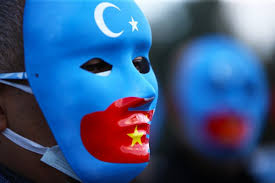
‘Break their lineage, break their roots, break their connections, and break their origins’. In 2014, President Xi Jinping launched the People’s War on Terror in XUAR, where Uyghurs are 90 per cent of the population. High-level officials followed up with orders to round up everyone who should be rounded up, wipe them out completely destroy them root and branch, and break their lineage, break their roots, break their connections, and break their origins. Officials described Uyghurs with dehumanizing terms and repeatedly likened the mass internment of Uyghurs to eradicating tumours. “
Rupturing of family bonds
Since 2014, the report says, Beijing has deployed Han cadres to reside in Uyghur homes as monitors . The government coerce, incentivise, and actively promote Han-Uyghur marriages to rupture Uyghur family bonds
Mass internment camps.
In 2017, under the De-Extremification regulations, mass internment of Uyghurs was legalised. A manual was issued with orders to police Uyghurs, speed up the construction and expansion of internment camps, increase discipline and punishment within the camps and maintain utmost secrecy
Children separated from parents.
Children, including infants, who have lost both their parents to internment or forced labour, have been confined to a vast network of massive State-run, highly securitized boarding schools.
Destruction of cultural symbols.
The Chinese government has eliminated Uyghur education, destroyed Uyghur architecture and household features, and damaged, altered, or completely demolished the vast majority of mosques and sacred sites in the region while closing off other sites or converting them into commercial spaces, the report said.
Detention of community leaders.
Intellectuals and community leaders have been selectively targeted via detention or death sentences. There are reports of mass death and deaths of prominent Uyghur leaders selectively sentenced to death by execution or, for elders in particular, by long-term imprisonment, the report added.
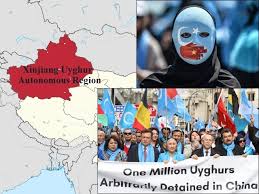
Who are the Uighurs.
● There are about 12 million Uighurs, mostly Muslim, living in north-western China in the region of Xinjiang,officially known as the Xinjiang Uyghur Autonomous Region XUAR .
● The Uighurs speak their own language, similar to Turkish, and see themselves as culturally and ethnically close to Central Asian nations.
● They make up less than half of the Xinjiang population.
● Recent decades saw a mass migration of Han Chinese China’s ethnic majority to Xinjiang, and the Uighurs feel their culture and livelihoods are under threat.
Where is Xinjiang.
● Xinjiang lies in the northwest of China and is the country’s biggest region.
● Like Tibet, it is autonomous, meaning – in theory – it has some powers of self-governance. But in practice, both face major restrictions by the central government.
● It is a mostly desert region, producing about a fifth of the world’s cotton.
● It is also rich in oil and natural gas and because of its proximity to Central Asia and Europe is seen by Beijing as an important trade link.
● In the early 20th Century, the Uighurs briefly declared independence, but the region was brought under the complete control of China’s new Communist government in 1949.
What are the allegations against China?
● Several countries, including the US, Canada and the Netherlands, have accused China of committing genocide defined by international convention as the intent to destroy, in whole or in part, a national, ethnical, racial or religious group.
● It follows reports that, as well as interning Uighurs in camps, China has been forcibly mass sterilising Uighur women to suppress the population and separating Uighur children from their families.
● US Secretary of State Antony Blinken has said China is committing genocide and crimes against humanity . ● UK Foreign Secretary Dominic Raab has said the treatment of Uighurs amounts to appalling violations of the most basic human rights .
● A UN human rights committee in 2018 said it had credible reports the Chinese were holding up to a million people in counter-extremism centres in Xinjiang.
● The Australian Strategic Policy Institute found evidence in 2020 of more than 380 of these reeducation camps in Xinjiang, an increase of 40% on previous estimates. ● Earlier, leaked documents known as the China Cables made clear that the camps were intended to be run as high security prisons, with strict discipline and punishments.
● People who have managed to escape the camps have reported physical, mental and sexual torture – women have spoken of mass rape and sexual abuse.
● In December 2020 research seen by the BBC showed up to half a million people were being forced to pick cotton. There is evidence new factories have been built within the grounds of the reeducation camps.
What was the build-up to the crackdown?
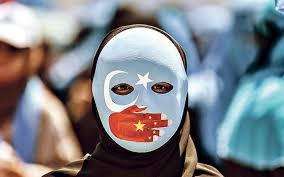
● Anti-Han and separatist sentiment rose in Xinjiang from the 1990s, flaring into violence on occasion. In 2009 some 200 people died in clashes in Xinjiang, which the Chinese blamed on Uighurs who want their own state. But in recent years a massive security crackdown has crushed dissent.
● Xinjiang is now covered by a pervasive network of surveillance, including police, checkpoints, and cameras that scan everything from number plates to individual faces. According to Human Rights Watch, police are also using a mobile app to monitor peoples’ behaviour, such as how much electricity they are using and how often they use their front door.
● Since 2017 when President Xi Jinping issued an order saying all religions in China should be Chinese in orientation, there have been further crackdowns. Campaigners say China is trying to eradicate Uighur culture
What does China say.
.jpeg)
● China has said reports it has detained Uighurs are completely untrue.
● It says the crackdown is necessary to prevent terrorism and root out Islamist extremism and the camps are an effective tool for reeducating inmates in its fight against terrorism.
● It insists that Uighur militants are waging a violent campaign for an independent state by plotting bombings, sabotage and civic unrest, but it is accused of exaggerating the threat in order to justify repression of the Uighurs.
● China has dismissed claims it is trying to reduce the Uighur population through mass sterilisations as baseless, and says allegations of forced labour are completely fabricated .
Source
https. http://www.bbc.com news worldasia-china-56986057 https. http://www.aljazeera.com news 2021 6 4 uighur-tribunal-hearsevidence-of-alleged-china-abuses https. apnews.com article onlyon-ap-middle-east-europegovernment-andpolitics-76acafdfb7cc9ef03c0dd0156eab https. http://www.bbc.com news worldasia-china-22278037 https. timesofindia.indiatimes.com world china rape-internment-camps-masssterilisation-how-china-iscommitting-genocide-of-uyghurs articleshow 81430955. cms
●
 Open Opinion.art
Leave a comment